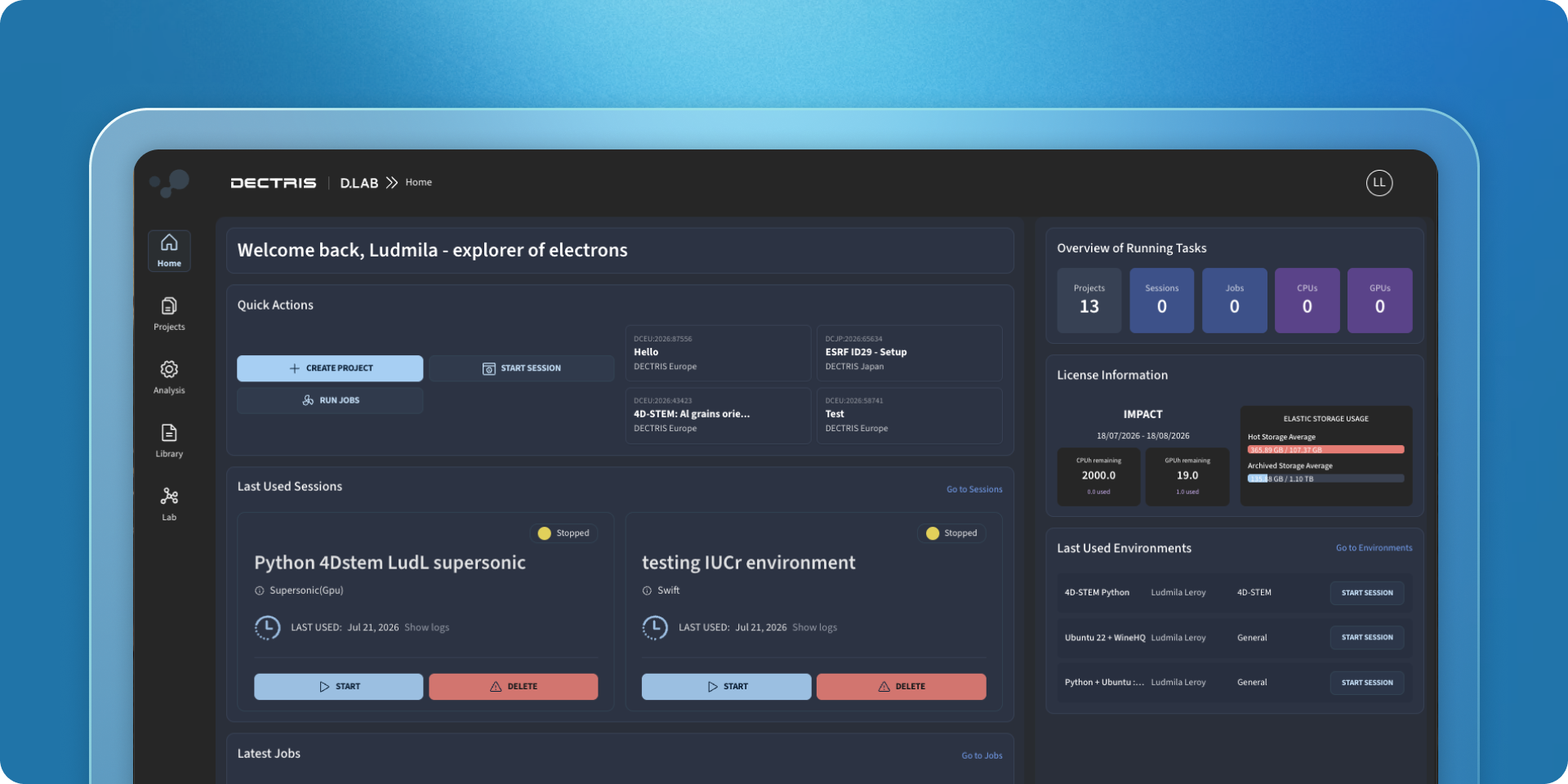
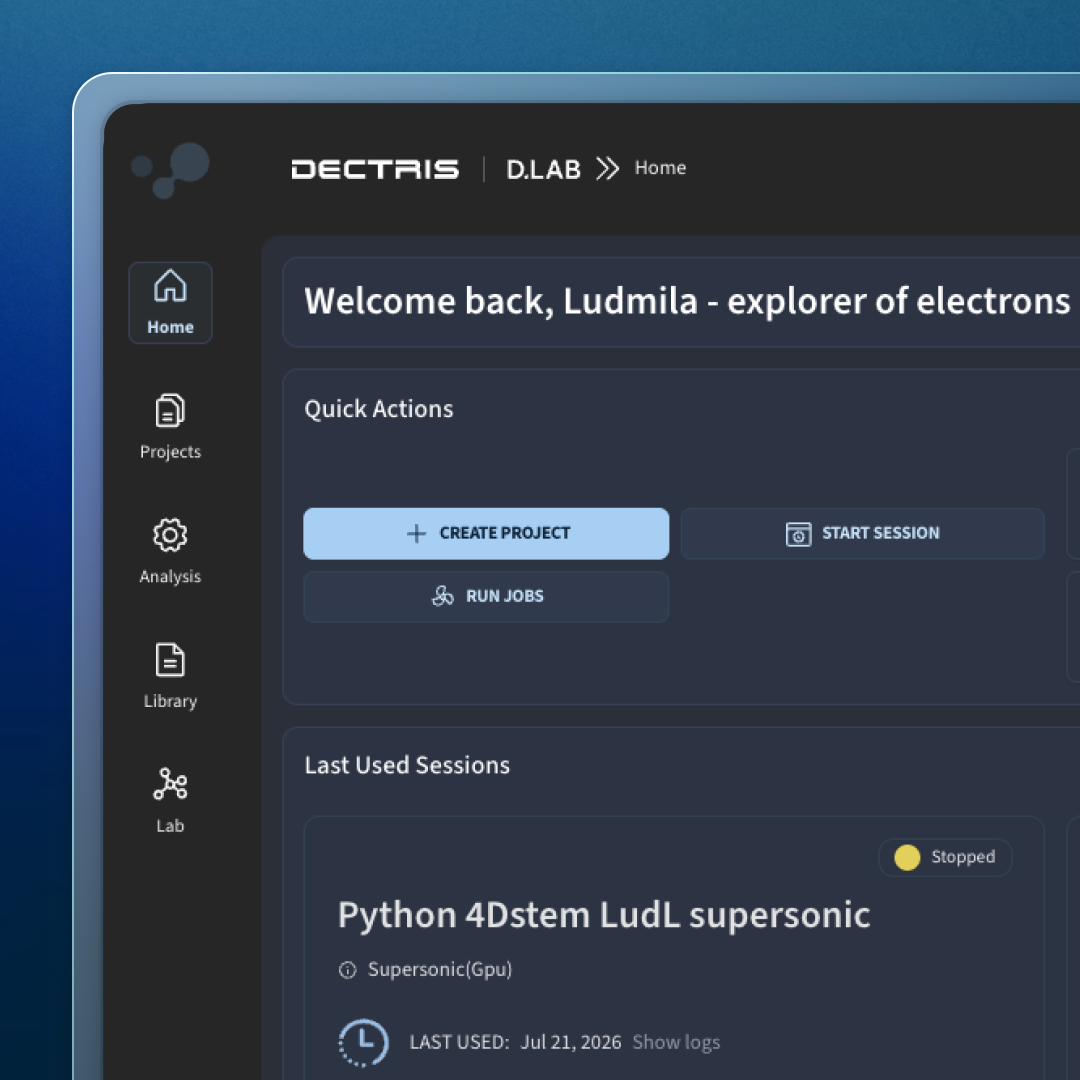
Research is scattered across instruments, storage, compute, and personal devices. DECTRIS D.LAB brings data, tools, analyses, and context together in one shared environment, giving your group a single home for its scientific work.
Scientific progress shouldn't start from scratch. DECTRIS D.LAB turns past analyses into reusable assets, allowing your team to build on previous work, community tools, and proven methods in minutes, not days.
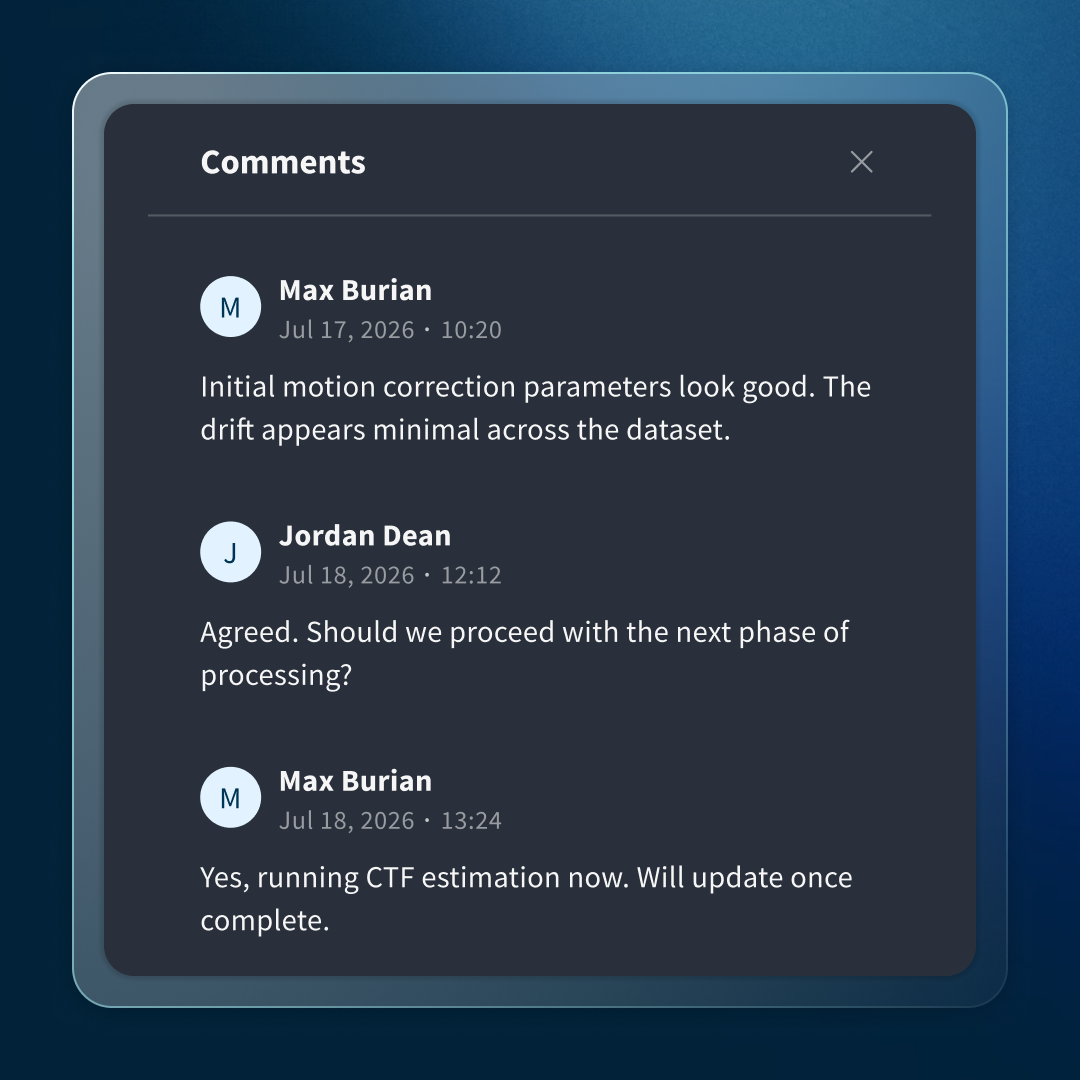
The best scientific decisions happen through collaboration. DECTRIS D.LAB keeps researchers, postdocs, and PIs connected throughout the analysis process, enabling feedback, discussion, and mentorship where the work happens.
A lab's most valuable asset is its accumulated knowledge. DECTRIS D.LAB preserves methods, decisions, analyses, and expertise so every project contributes to a growing body of knowledge that survives across generations of researchers.
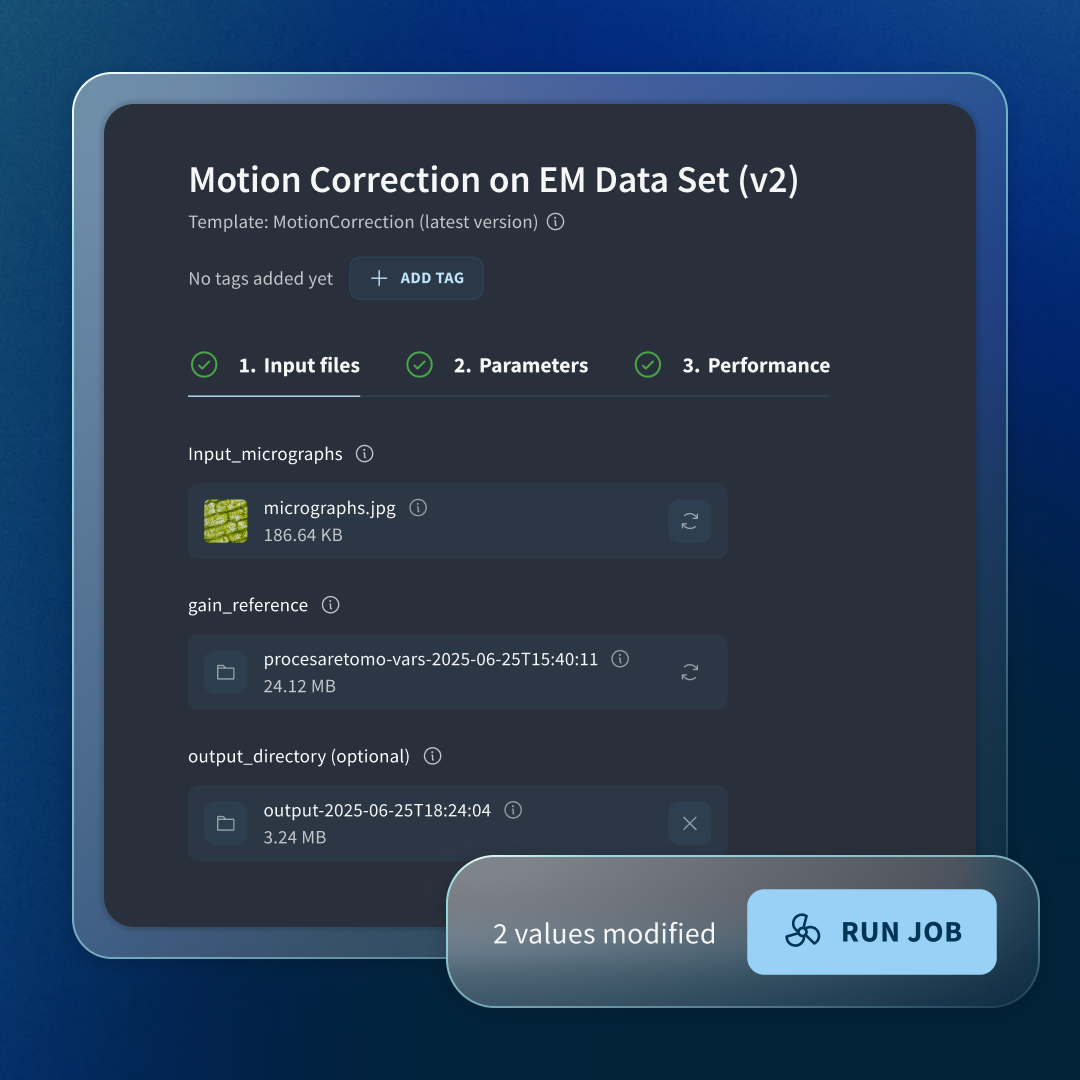
Pick your data and your workflow — from your group's catalogue, your past runs, or 30+ community-built tools, all preinstalled and ready to go. No install. No script translation. No environment to set up.
2. Run anywhere
Hit go. The workflow executes inside an immutable container — same result on 2 CPUs, 8 GPUs, the campus cluster, or soon, your own server. Scale by picking a node, not by rewriting code.
3. Discover, analyze, share
Every run is a persistent snapshot — inputs, software, scripts, outputs, results. Analyze inline. The Principal Investigator comments where decisions are made. Share the workflow with reviewers, collaborators, or the community.
A place where today’s work becomes tomorrow’s starting point
Shared analysis space
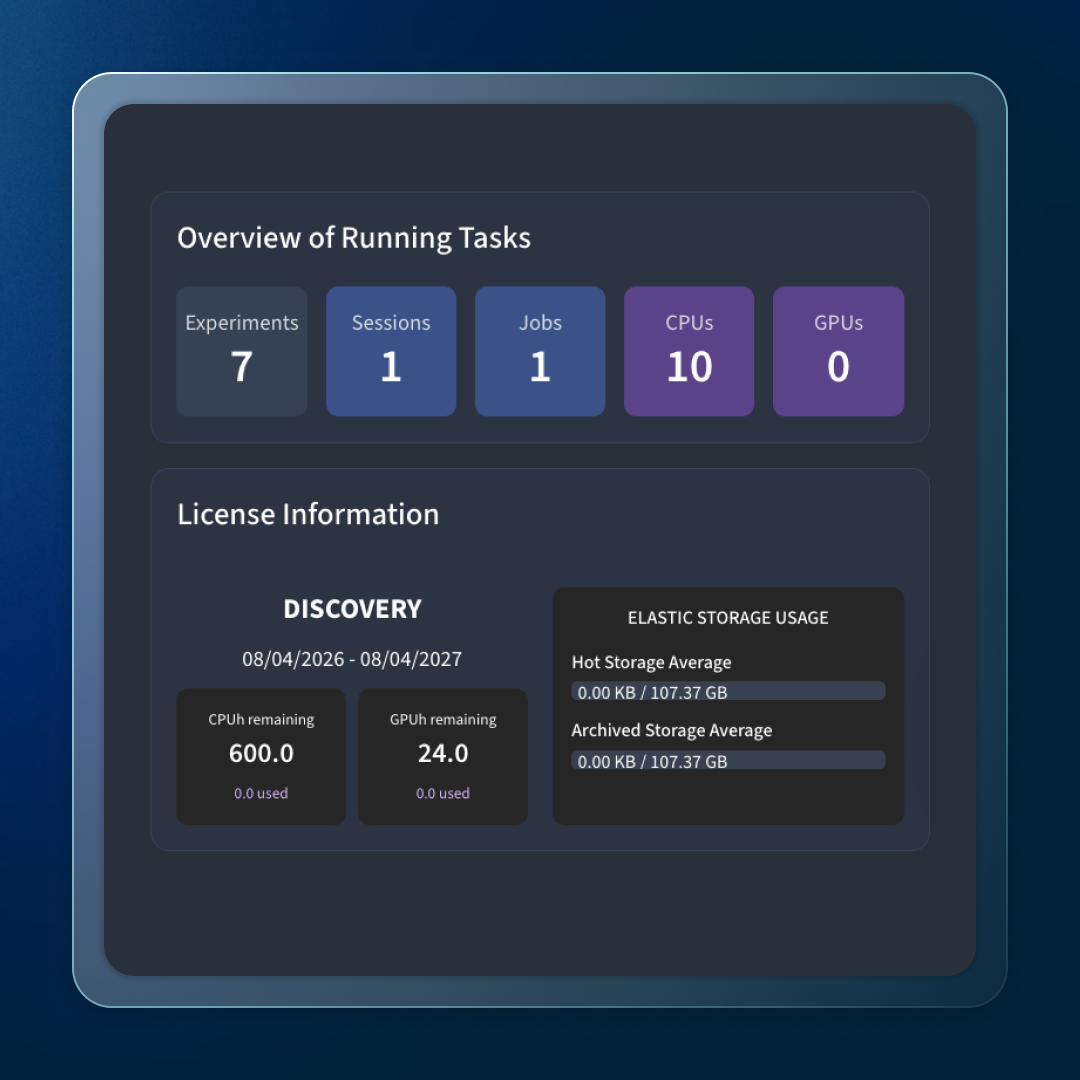
One workspace where your group's projects, data, and analyses live together — every member sees what's running, what's done, what's next.
Community tools, preinstalled
30+ vetted analysis tools ready to run on day one — no install, no script translation, no version-conflict triage.
Live collaboration
Comment inline on any run, any iteration. Mentors guide where decisions are made; students stop guessing. The PI is back in the work.
Direct-from-detector upload
Up to 95 Gbit/s per device. The data is in the workspace before the experiment is over — no drive staging, no Dropbox relay.
Automated versioning
Every run captures data, software, workflow, and results as an immutable snapshot — versioned automatically. Roll back, fork, or rerun anything.
Built on open standards
Open formats. Standard containers. Portable workflows. Everything can be reused and transposed to other systems outside of DECTRIS D.LAB, with no lock-in.
“DECTRIS D.LAB helps us focus on results and insights from large-scale data. It offers much-needed functionality to reproduce, share, and work together in this upcoming era of real-time open and community-driven science.”
Sagar Khavnekar
Independent Scientist, Subspatial
what scientists are saying
“Hosting a hands-on workshop of this scale would have been nearly impossible without the support of DECTRIS D.LAB. Providing each participant with instant access to high-performance computing resources allowed us to focus on the scientific underpinning rather than the technical setup.”
Tilman Grünewald
CNRS researcher (COMiX team), Institut Fresnel
what scientists are saying
“DECTRIS D.LAB made it straightforward to set up and share my software environment for our particle physics simulation workflow, which I can now re-run with configurable input in just a few clicks.”
Philip Ploner
Student, ETH Zürich
what scientists are saying
"Once we go to the beamline, we come back and process the data on the platform. The interactive support is really helpful, and I'm quite happy. I want to keep using it, definitely."
Jacopo Tessarollo
Group Leader, Chomnan University
CONTACT US
Get in touch
Thank you! Your submission has been received!
Oops! Something went wrong while submitting the form.
Thank you! Your submission has been received!
Oops! Something went wrong while submitting the form.